
MCP vs CLI vs API: Which Layer Does Your AI Agent Actually Need?
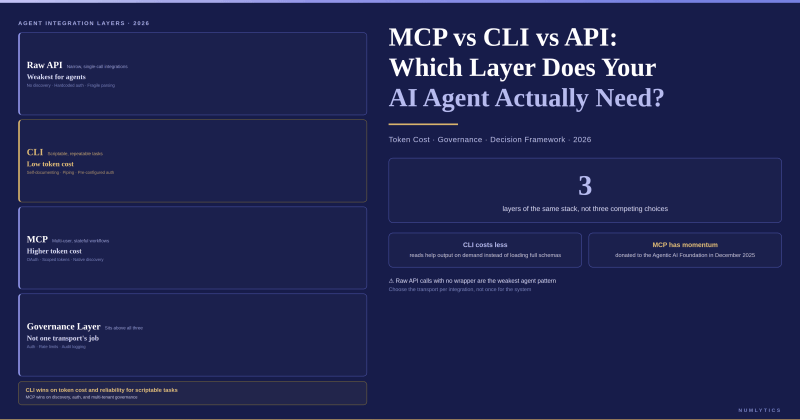
MCP, CLI, and API keep getting framed as a fight to the death. In production, they're three layers of the same stack - the real question is which layer fits which integration, not which one wins.
The MCP vs CLI vs API debate has been running loud enough in developer circles that it's easy to miss the more useful question underneath it: MCP, CLI, and raw API access aren't three competing answers to the same problem. They're three layers of the same stack, each solving a different part of getting an AI agent to reliably do something in the real world. The teams shipping the most reliable production agents in 2026 aren't the ones that won the CLI-vs-MCP argument - they're the ones that stopped treating it as an argument and started asking which layer fits which integration.
This is a companion piece to our earlier post on why MCP needs a CLI, which focused on the CLI-first build pattern. This post widens the lens to include the layer underneath both of them - the raw API - and brings in the concrete token, cost, and reliability data that's emerged from real production comparisons across 2026, plus the governance argument that actually matters more than which transport you pick.
Three Layers, Not Three Competitors
Precision matters here because the debate only makes sense once each term is defined narrowly. An API is the stateless request-response transport - HTTP, typically REST or GraphQL - that a service exposes underneath everything else. A CLI wraps that API into named terminal commands, handling authentication, argument parsing, and output formatting so a human or an agent can invoke it without writing raw HTTP client code. MCP sits above the API too, but built specifically for models: it gives an agent a structured way to discover and invoke tools at runtime, with the MCP server translating each call into the underlying API request behind the scenes.
None of the three is a substitute for the other two. A serious MCP server is usually backed by an API underneath it - MCP is the adapter between an API and an agent, not a replacement for the API itself. And forcing a model to call a raw API directly with something like curl, then parse the raw response itself, is the one genuinely weak pattern of the three - it works in a demo and reliably falls apart in production, costing exactly the context and parsing reliability that a CLI or MCP layer would have handled for free.
API: The Transport Everything Else Sits On
Direct, unwrapped API calls are the simplest pattern to start with - write a request, handle the response, done - and that simplicity is also the limitation. Every consumer of a raw API, human or agent, has to independently handle authentication, pagination, retries, and error handling, and an agent calling raw APIs directly inherits all of that complexity in its own reasoning loop rather than offloading it to a layer designed to absorb it. Raw API access earns its place for narrow, well-understood, single-call integrations where the overhead of a CLI or MCP wrapper genuinely isn't worth building - but it's rarely the right default for anything an agent will call repeatedly or compose with other calls.
CLI: Fast, Cheap, and Already Battle-Tested
A CLI-driven agent flow is simple in shape: generate a command, execute it, read the output, continue reasoning. That simplicity is exactly why it performs well - it's fast, predictable, requires no additional network hop for local tools, and rides on decades of Unix tooling already deeply represented in the training data of most frontier models. Vendor-maintained CLIs for major platforms (AWS, GitHub, Google Cloud) are actively kept current by the same teams that own the underlying service, which means an agent calling them is working against documentation and behavior that's genuinely up to date.
MCP: Discovery, Structure, and Governance
MCP's real advantage shows up precisely where CLI's simplicity becomes a liability: services with no mature CLI, workflows that need OAuth or dynamic, per-user authentication rather than shared local credentials, and multi-step, stateful interactions where an agent needs to discover what's available rather than have it hardcoded. MCP has also gained real institutional momentum since its release - Anthropic donated the protocol to the Agentic AI Foundation under the Linux Foundation in December 2025, with Anthropic, Block, and OpenAI as founding members, and OpenAI has moved to deprecate its own proprietary Assistants API in MCP's favor. That consolidation is a meaningful signal that MCP is becoming the standard discovery and invocation layer for agent tooling generally, not just an Anthropic-specific pattern.
The Numbers: What CLI vs MCP Actually Costs
Beyond the architectural argument, comparative testing across 2026 has started putting real numbers behind the CLI-vs-MCP tradeoff. One widely cited comparison ran the same set of GitHub-related tasks through Claude Sonnet 4 using CLI, CLI with a skills file, and MCP, and found CLI completed tasks reliably nearly every time while consuming a small fraction of the tokens MCP's tool schemas required - MCP's larger, more complete tool descriptions meant substantially higher token cost per task, translating into meaningfully higher operating cost at volume. Separately, Perplexity's engineering team has described MCP tool descriptions consuming the large majority of an agent's available context window before any actual work began, once enough tools were registered simultaneously - a concrete illustration of why MCP's discovery mechanism, valuable as it is, isn't free.
These figures should be read as illustrative of a real, structural tradeoff rather than as a universal constant - token costs shift as MCP implementations improve their schema design and as progressive tool discovery patterns mature. But the direction is consistent across every source we reviewed: CLI wins decisively on raw token efficiency and reliability for well-defined, scriptable tasks; MCP wins on security isolation, multi-tenant auth, and standardized discovery across heterogeneous, less-scriptable tools.
Governance Sits Above the Transport, Not Inside One Choice
It's tempting to treat MCP as inherently "the secure one" and CLI as inherently risky, but that framing collapses under real deployment conditions. A CLI, unless explicitly sandboxed, runs with the full permissions of whatever session invokes it - but CLI sandboxing is itself a mature discipline with decades of tooling behind it, from container isolation to fine-grained OS-level permission controls. MCP does provide better default credential isolation, since secrets stay server-side and agents receive scoped tokens rather than raw credentials - but that advantage only holds if the MCP server itself is properly audited and configured, which is not automatic just because a system uses MCP.
The more useful framing: centralized authentication, scoped permissions, rate limiting, and audit logging need to sit in a governance layer above whichever transport an agent uses - routing both MCP traffic and CLI-initiated API calls through the same gateway, with consistent policy enforcement regardless of which interface a given integration happens to use. Once that governance layer exists, the transport choice for any individual tool becomes an implementation detail rather than a security decision made once for the whole system.
How This Actually Resolves: Skills Over Transport
The most instructive real-world pattern comes from how production agent products have quietly resolved this debate internally rather than continuing to argue about it publicly. Developer-facing coding agents commonly run shell commands directly for local work - piping data through familiar Unix tools - while also connecting to MCP servers for SaaS integrations that need broader, less-scriptable access. The transport, in both cases, sits underneath a higher-level abstraction: the agent invokes a capability, and a routing layer decides whether that capability is best served by a shell command or an MCP tool call, without the agent itself needing to reason about the distinction on every turn.
If you're designing an agent integration from scratch, the transport decision doesn't need to be made once for the whole system. It's cleaner to make it per-integration - CLI where a mature, scriptable option already exists; MCP where auth, discovery, or multi-tenancy genuinely require it - and abstract both behind a consistent, higher-level interface the agent actually reasons against.
A Two-Layer Decision Framework
The most useful way to apply all of this is as two separate decisions, made at two different levels.
| Dimension | Raw API | CLI | MCP |
|---|---|---|---|
| Best for | Narrow, single-call integrations | Scriptable, well-defined, repeatable tasks | Multi-user, stateful, discovery-driven workflows |
| Token / context cost | Depends entirely on response size | Low - read on demand | Higher - schemas loaded upfront |
| Auth model | Whatever the agent implements itself | Pre-configured, session-scoped | Per-user OAuth, scoped tokens, server-side secrets |
| Discovery | None - must be hardcoded | Self-documenting via help output | Native, standardized across tools |
| Maturity for agent use | Weak - demo-only in most cases | Decades of tooling and training data | Growing fast, institutionally backed |
- API, CLI, and MCP are three layers of the same stack, not three competing choices - a serious MCP server is usually backed by an API underneath it, and treating MCP as a substitute for the API itself is where architectures get fragile.
- CLI wins decisively on token efficiency and reliability for scriptable, well-defined tasks; MCP wins on security isolation, multi-tenant auth, and standardized discovery for stateful, less-scriptable workflows.
- MCP's institutional momentum is real - donated to the Agentic AI Foundation under the Linux Foundation in December 2025, with OpenAI deprecating its own Assistants API in MCP's favor - but institutional backing doesn't erase its per-call token cost.
- Governance - centralized auth, scoped permissions, rate limiting, audit trails - needs to sit above the transport layer, applied consistently regardless of whether a given integration uses CLI or MCP, rather than being treated as a property of one transport choice.
- Production agent products increasingly resolve this by routing per-integration through a higher-level abstraction (often called Skills) that picks the transport automatically - making the CLI-vs-MCP decision an implementation detail rather than an architecture-wide commitment.
Numlytics' AI and machine learning consulting practice designs the integration architecture behind production AI agents - including the governance layer, transport selection, and tool interface design that determine whether an agent integration actually holds up past a demo. Speak with a certified consultant about the right mix of API, CLI, and MCP for your specific integrations.